The Garden 19
Every note, filterable by growth stage and topic. Some are still unwritten.
Tools and practices 5
-

Welcome to the Garden
What this digital garden is and how to wander it.
- Seedling
Spaced Repetition
Reviewing material at increasing intervals to fight forgetting.
- Seedling
System calls: the border crossing
Your program cannot touch the disk, the network, or another process on its own - only the kernel can. A system call is the one controlled crossing into kernel space, and every crossing has a toll.
- Seedling
Memory models: the rules behind happens-before
Single-threaded code runs in the order you wrote it. Put a second thread on the same memory and that stops being true - a memory model is the contract for which writes a thread is guaranteed to see, and when.
- Budding
Garbage collection: the pause you didn't schedule
Automatic memory management removes a class of bugs by deciding for you when memory is safe to reclaim. You pay for that convenience in a currency that only shows up under load - pauses, CPU, and headroom.
- Seedling
The cost of async
Async is sold as strictly faster. It is really a trade - cheap concurrency for work that waits, paid for with allocation, scheduling, and lost locality that CPU-bound code gets nothing back for.
- Seedling
Async/await: syntax over a state machine
The keyword does not make code fast or parallel. It rewrites a function into something that can pause and resume, so one thread can be partway through thousands of waits at once.
- Budding
The Go scheduler: G, M, and P
How Go runs hundreds of thousands of goroutines on a handful of OS threads - the G-M-P model, local run queues, work-stealing, and the syscall handoff.
- Budding
Threads vs coroutines: who decides to yield
Both let a program do many things at once. The real difference is who is in control - the kernel that preempts a thread, or the coroutine that yields itself - and what each "thing" costs.
- Budding
CPU-bound vs IO-bound
Whether your program spends its time computing or waiting decides your concurrency model - and quietly picks the language that will feel effortless.
- Evergreen
Rate limiting as an invariant
A rate limit reads like a restriction from outside and like a promise from inside - the invariant that keeps a system in a regime where it still works.
-
 Evergreen
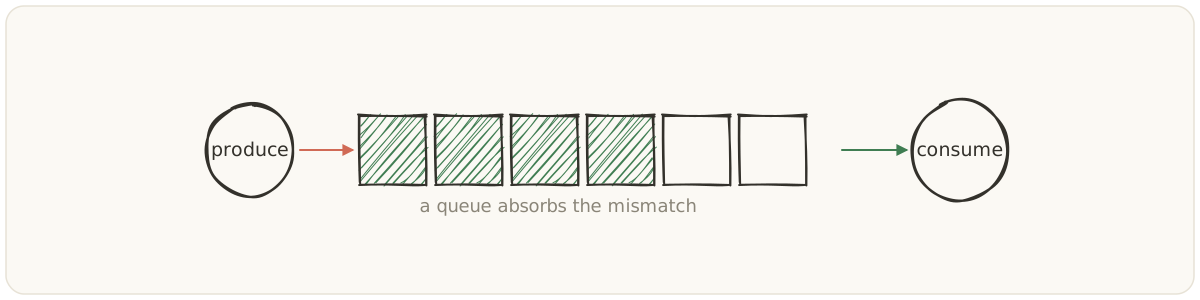
Queues Are Everywhere
A queue decouples a producer from a consumer so they need not move at the same speed. Most of the queues in a system are the ones nobody drew on the diagram.
- Seedling
Retries and idempotency
Retries are only safe when the operation is idempotent - otherwise you get duplicate records or double charges.
- Seedling
Why APIs break
Breaking changes usually trace back to versioning, contracts, and team coordination - not just code.
-
 Evergreen
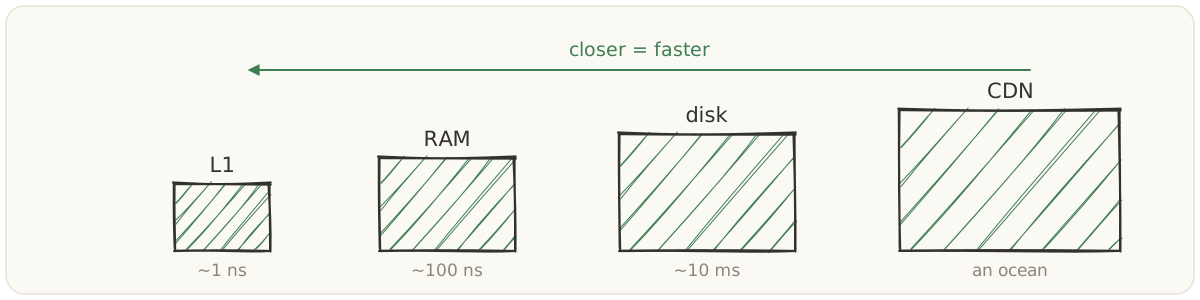
Caching Isn't Cheating
Caching gets dismissed as a hack, but it is one of the oldest principled moves in computing - spending space, and a little staleness, to buy time.
-
 Evergreen
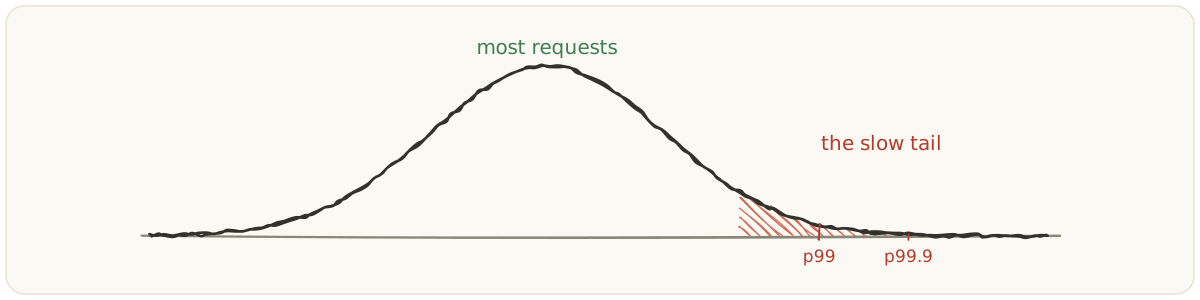
Tail latency: the number the average hides
The average request looks fine while the slowest one percent decides your reputation. Why tails happen, and how to defend them.
- Evergreen
Latency vs Throughput vs IOPS: why your fast API still fails at scale
Three performance numbers people blur together - and how the workload decides which one you should be optimizing.
- Budding Map of Content
How Programs Actually Run MOC
A map of the runtime notes - how a program is scheduled onto threads and cores, how it shares memory without corrupting it, and what it costs to leave your own process.
- Budding Map of Content
Performance & Latency MOC
A map of the performance notes - how to measure speed, the mechanisms that create it, and how to keep it under load.
No notes match those filters.